
Best Well Water Test Kit – Accurate Water Testing
Test your well water accurately with the Best Well Water Test Kit. Detect impurities, chemicals, and ensure safe water at home.

Affiliate disclosure: Some links on this page are affiliate links. If you click an affiliate link and make a purchase, I may earn a small commission at no extra cost to you. I only recommend products I believe are useful to readers.
A home strip that reports in under a minute and a mailed 256-analyte laboratory panel are both sold as well-water test kits, but they answer different questions. The useful choice starts with the well’s local risks—bacteria, nitrates, metals, or pesticides—before speed, kit size, or price.
Testing your well water regularly helps you know what’s in it and whether it’s safe to drink. Well water test kits let you check your water quality at home without hiring expensive professionals.
These kits come in different types, from simple strips that test a few basic things to comprehensive kits that screen for dozens of contaminants. Some kits give you results right away, while others require you to mail samples to a lab for detailed analysis.
The most important factor when choosing a test kit is what contaminants you want to check for. Basic kits test for common issues like bacteria, pH levels, and hardness.
More advanced kits can detect heavy metals, pesticides, and other dangerous chemicals. You should also consider whether you want instant results or more accurate lab testing.
Best Well Water Test Kits
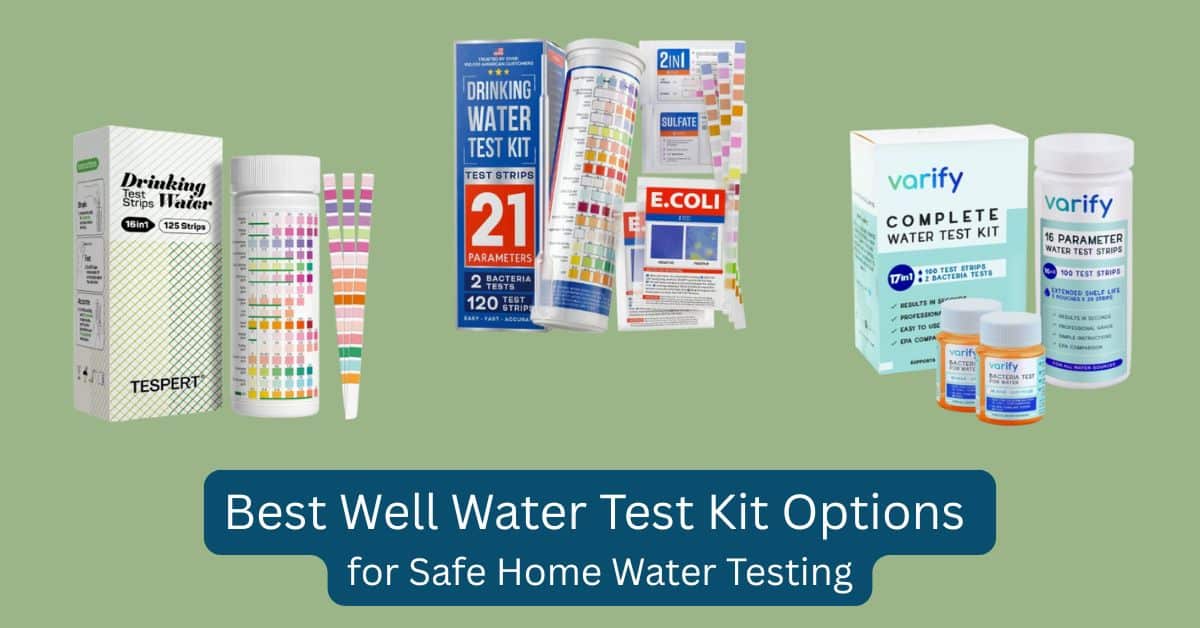
Below is my full list of the best well water test kits. I compared the number of parameters, delivery method, turnaround time, and published product details to help match each kit to the right use case.
Varify 17in1 Complete Water Test Kit

Best for homeowners who want broad at-home testing across many common well water concerns.
Key specs: tests 17 parameters; 100 strips + 2 bacteria tests; the listing states bacteria results in 48 hours (Varify 17-in-1 Complete Water Test Kit listing, Amazon)
Pros
- Tests for seventeen different contaminants including lead, bacteria, and chlorine in one kit
- Color-coded strips make reading results simple without guessing what numbers mean
- Bacteria tests give you thorough results in just 48 hours
Cons
- More expensive than basic test strips that only check a few things
- Takes two full days to get bacteria test results back
- Might test for some things your well water doesn’t actually need checked
Tap Score Advanced Water Test Kit

Best for well owners who want broad lab-based contaminant analysis.
Key specs: lab test for 114 analytes; results in 5 business days; 12-month kit shelf life (Tap Score Advanced Well Water Test, SimpleLab/Tap Score)
Pros
- Tests for 116 different contaminants including bacteria, heavy metals, and industrial chemicals
- Professional lab analysis with detailed reports returned in just 5 business days
- Expert support available from PhD scientists to help interpret results
Cons
- More expensive than basic test kits on the market
- Kit expires within 12 months of purchase requiring prompt use
- Some users find the extensive results overwhelming without professional guidance
HEVEIS 21-in-1 Water Test Kit

Best for homeowners who want regular water testing at home.
Key specs: the listing states 21-in-1 test strips; 120 test strips; 4 bacteria tests (HEVEIS 21-in-1 Water Test Kit listing, Amazon)
Pros
- Testing 124 times saves hundreds compared to lab costs
- Clear color chart makes reading results simple and fast
- Covers 21 different water problems including bacteria testing
Cons
- Test strips may not be as accurate as professional lab tests
- Color matching can be tricky in poor lighting conditions
- Record cards fill up quickly with frequent testing
TESPERT 16-in-1 Water Test Kit

Best for well owners who want extensive water analysis at an affordable price point.
Key specs: 16-in-1 strips; 125 strips included; 30-second initial screening (TESPERT 16-in-1 Water Test Kit listing, Amazon)
Pros
- Tests 16 different water parameters including heavy metals and chemical contaminants
- Provides 125 test strips that deliver exceptional value compared to lab testing costs
- Results appear quickly and are easy to read with clear color comparisons
Cons
- Strip readings can be difficult to interpret accurately in certain lighting conditions
- Some parameters show less precise results than professional laboratory analysis
- Color chart matching requires good eyesight and careful comparison
Watersafe Original Water Testing Kit

Best for buyers who want a lower-cost kit focused on a smaller contaminant panel.
Key specs: the listing states it tests 9 contaminants (lead, bacteria, iron, copper, chlorine, nitrates, and more); detects lead at 5 ppb; detects bacteria at 1 organism/mL (Watersafe Original Water Testing Kit listing, Amazon)
Pros
- Tests for nine different contaminants including dangerous lead and bacteria in one convenient package
- Delivers results quickly with most tests completing in 30 minutes or less
- Costs much less than sending water samples to professional labs
Cons
- Bacteria testing requires a full 48-hour wait period for accurate results
- pH test strips can show slight color changes after the initial reading
- Instructions could be clearer for first-time users testing their own wells
Mighty Care 21-in-1 Water Test Kit

Best for homeowners who want regular water monitoring.
Key specs: 21-in-1 test strips; 147 strips total (145 + 2); results in 15 seconds (Mighty Care 21-in-1 Water Test Kit listing, Amazon)
Pros
- Gets results in just 15 seconds with clear color matching
- Tests 21 different water parameters including metals and pH levels
- Comes with 147 strips for long-term testing needs
Cons
- Color readings can be hard to distinguish for some water conditions
- May not detect very low levels of certain contaminants
- Results might vary between different water sources
Palinoia 22 in 1 Water Test Kit

Best for buyers who want a broad strip-test kit with many parameters in one box.
Key specs: the listing states 24-in-1 test strips; 165 strips total (125 main + 40 specialty); 2 bacteria test jars (E. coli and coliform); main strips read in 60 seconds (Palinoia 22-in-1 Water Test Kit listing, Amazon)
Pros
- Tests 24 water quality factors including lead, iron, and pH, plus 2 dedicated bacteria jars for E. coli and coliform
- Results appear within 60 seconds of dipping the strip
- Compact size fits easily in a toolbox or kitchen drawer
Cons
- Strip tests provide less accuracy than lab analysis
- Color matching can be difficult in poor lighting conditions
- Instructions could be clearer for reading certain results
Watersafe Bacteria Water Test Kit

Best for well owners who need fast, accurate bacteria testing.
Key specs: bacteria test (coliform incl. E. coli and non-coliform); the listing states it detects as low as 1 bacteria/mL; results in 6-48 hours depending on contamination level and temperature (Watersafe Bacteria Water Test Kit listing, Amazon)
Pros
- Delivers results in as little as 6 hours instead of waiting days for lab reports
- Catches even tiny amounts of bacteria that other home tests might miss
- Works for all water sources from wells to pools with simple shake-and-wait testing
Cons
- Only includes one test per package which makes it pricey for regular monitoring
- Instructions use very small print that can be hard to read
- Takes up to 48 hours for results in cooler weather or low contamination levels
Tap Score Ultimate Water Test

Best for those who want the most thorough water analysis possible.
Key specs: the listing states a lab test for 256 total contaminants and analytes; results within 5 business days; 12-month kit shelf life (Tap Score Ultimate Water Test listing, Amazon)
Pros
- Tests over 250 contaminants including bacteria, heavy metals, and chemical compounds
- Certified lab network provides accurate results with detailed health recommendations
- Expert support from scientists available through direct chat for questions
Cons
- Higher price point compared to basic home testing strips
- Results take several days to receive from the lab
- One-year shelf life means you cannot store it indefinitely
HOVIRAN 18-in-1 Water Test Strips

Best for buyers who want a low-cost strip kit with a broad parameter list.
Key specs: the listing states 18-in-1 strips (hardness, chlorine, bromine, iron, copper, lead, mercury, nitrate, nitrite, manganese, sulfate, zinc, fluoride, sodium chloride, alkalinity, carbonate, pH); 125 strips included; 2-second dip, read within 30 seconds (HOVIRAN 18-in-1 Water Test Strips listing, Amazon)
Pros
- Tests for 18 different water quality issues including lead, iron, and water hardness in just 30 seconds
- 125 test strips included
- Simple three-step process makes testing water quality easy for anyone
Cons
- Color differences on some test results are hard to tell apart, especially for sodium levels
- Results may not be as precise as professional lab testing for critical health concerns
- Reading results requires good natural lighting to match colors accurately
Safe Home DIY Bacteria Test Kit

Best for buyers who want a bacteria-only test with a faster at-home turnaround.
Key specs: DIY bacteria test; the listing states it detects 50 coliform species incl. E. coli; detects down to 1 organism; results as fast as 6 hours, up to 72 hours depending on incubation conditions (Safe Home DIY Bacteria Test Kit listing, Amazon)
Pros
- Gets results in just 24 hours instead of waiting days for lab results
- Finds 50 different types of harmful bacteria including E. coli
- Comes with clear instructions that are easy to follow
Cons
- Only tests for bacteria, not other water problems like chemicals or metals
- More expensive than basic test strips but less thorough than full lab tests
- Small sample size means you need to be careful when collecting water
Tap Score Essential Home Test

Best for buyers who want lab analysis plus access to professional interpretation support.
Key specs: lab test for 54 analytes; results in 5 business days; 12-month kit shelf life (Tap Score Essential Well Water Test, SimpleLab/Tap Score)
Pros
- Lab results come back fast in just 5 business days
- Professional scientists answer questions through direct chat
- Tests check for over 50 different things in your water
Cons
- Costs more than basic test strips or simple kits
- Registration process can be confusing and hard to manage
- Results show company standards instead of government levels
Buying Guide
The real choice with a well water test kit is between two tools built for different jobs: strips that give you a colour-matched reading in under a minute, and lab kits where you mail in a sample and wait several business days for a written report. Strips are good for routine screening, but the “-in-1” number on the box tells you less than it seems to — the kits on this list range from single-purpose bacteria strips up to a 256-analyte lab panel, so what the kit actually tests for matters more than how many boxes it checks. What you need to test for should follow what your well is actually at risk from: properties near farmland lean toward pesticide testing, older homes toward lead, and a kit that only checks bacteria, like the dedicated bacteria-only kits here, won’t tell you anything about metals or other chemicals.
What to Test For
Bacteria and nitrates belong in a baseline well screen, then the property determines what to add: pesticides near farmland, lead in an older home’s plumbing, plus pH, hardness, arsenic, or chlorine where those are relevant.
The broader checklist includes:
- Heavy metals like lead and arsenic
- pH levels
- Hardness minerals
- Chlorine and other chemicals
Kit Types
A mailed lab kit trades several business days for a written multi-analyte report, while home strips provide a faster colour-matched screen with less precision. Digital meters cover one parameter at a time, such as pH, and should not be treated as substitutes for bacteria or metals analysis.
Important Features
| Feature | Why It Matters |
|---|---|
| Clear instructions | Easy sample collection |
| Fast results | Know problems sooner |
| Multiple tests | Check many issues at once |
| Good packaging | Keeps test materials fresh |
Instructions and packaging affect whether the sample stays valid, while turnaround time controls how soon the result can guide treatment. Count the named analytes the well needs rather than treating a larger “in-1” label as better coverage.
Cost Considerations
The basic kits described here cost about $20-50 USD, while broader laboratory panels run about $100-300 USD. Compare cost per required analyte and avoid paying for a large panel that still omits the local risk the test is meant to answer.
Accuracy Matters
For a mailed sample, verify the laboratory’s certification and the method used for each result rather than relying on package claims. For strips, compare detection range, timing instructions, and colour scale with the concentration the well needs to screen.
Frequently Asked Questions
Well water testing raises common questions about selection criteria, result interpretation, and testing frequency. Most people want to know which contaminants test kits detect and whether professional services are necessary.
When is a mailed laboratory panel worth choosing over an instant home strip?
Choose the laboratory panel when the decision depends on a precise result for bacteria, nitrates, lead, pesticides, or another named analyte. Use instant strips for routine screening when their detection range covers the parameter and a colour-matched estimate is sufficient.
Consider your local water issues too. Areas near farms need pesticide testing.
Older homes require lead testing. Check if the kit uses a certified lab.
Labs with EPA or state certification give more reliable results. Price matters, but cheap kits often miss important contaminants.
Spending $150-300 (USD) gets better coverage than $50 (USD) kits.
How do I interpret the results from a home well water test?
Most test kits show results in parts per million or milligrams per liter. The kit instructions explain what numbers mean danger.
Compare your results to EPA drinking water standards. The EPA sets maximum safe levels for each contaminant.
Red or positive results usually mean problems. Green or negative results typically mean safe levels.
Call your local health department if results show unsafe levels. They can explain next steps and treatment options.
What contaminants do top-rated well water test kits typically detect?
Most good kits test for bacteria like E. coli and coliform. These cause immediate illness and need fast treatment.
Heavy metals get tested too. Lead, arsenic, and mercury are common in well water test kits.
Nitrates and nitrites show up in most comprehensive kits. These come from fertilizers and septic systems.
Many kits also check pH levels, hardness, and chlorine. Some advanced kits test for pesticides and volatile organic compounds.
Are there any well water test kits that can be used for multiple types of analyses?
Yes, comprehensive kits test for dozens of contaminants at once. These cost more but give complete water pictures.
Some kits let you choose which tests to run. You pick bacteria testing one month and heavy metals the next.
Multi-stage kits exist too. You test basic contaminants first, then add advanced testing if needed.
Laboratory services offer custom panels. You select exactly which contaminants to test based on your concerns.
How often should I test my well water using a test kit?
At minimum, annual bacteria testing is a common recommendation because contamination can appear quickly.
Test for other contaminants every 2-3 years if previous results were good.
Test immediately after any changes. New septic systems, nearby construction, or strange tastes require quick testing.
Areas with known contamination need more frequent testing. Check with local health departments about recommended schedules.
Is it necessary to use a professional service for well water testing, or can I rely on a home test kit?
Home test kits are most useful for basic screening and regular monitoring. They cost less and usually provide faster preliminary results than lab panels.
Professional labs provide more accurate results for complex contaminants. They can detect lower levels than home kits.
Use professional testing when buying a home or after contamination events. Banks often require certified lab results for mortgages.

Thomas Peterson
Owner WSA
About the Author
Latest Posts
Born and raised in Nanaimo on Vancouver Island. Thomas gained a deep appreciation for the importance of clean, reliable water. With over 15 years of experience working with water treatment systems, Thomas has become a trusted expert in helping local homeowners and businesses resolve the unique challenges of well water across the Island.
From hard water and iron buildup to low water pressure and sediment issues, Thomas takes a practical, no-nonsense approach to solving water problems. Whether it’s installing filtration systems or troubleshooting well pump issues, Thomas focuses on long-lasting solutions that help people get the clean, safe water they need.
As a proud local professional, Thomas is dedicated to serving his community with honesty, quality service, and expert advice tailored to the water conditions of Vancouver Island.
Areas of Expertise: Well Service, Well Pumps, Water Filtration Systems
- Clack Water Softener Alternatives: Top Systems for Hard Water Treatment in 2025 November 8, 2025
- Best Well Water Test Kit Options for Safe Home Water Testing in 2025 November 5, 2025
- Best Well Water TDS Meter for Accurate Home Testing in 2025 November 1, 2025
- Best Well Water Sediment Filter Systems for Clean Home Water in 2025 October 29, 2025
- Best Well Water Saltless Water Softener Systems for 2025 October 26, 2025
Facebook Twitter LinkedIn Instagram Reddit
Fact Checked & Editorial Guidelines
The Fact Checking Process
I prioritize accuracy and integrity in my content. Here’s how I maintain high standards:
- Expert Review: All articles are reviewed by subject matter experts.
- Source Validation: Information is backed by credible, up-to-date sources.
- Transparency: I clearly cite references and disclose potential conflicts.
Your trust is important. Learn more about my fact checking process and editorial policy.
Reviewed by: Subject Matter Experts
The Review Board
The content is carefully reviewed by experienced professionals to ensure accuracy and relevance.
- Qualified Experts: Each article is assessed by specialists with field-specific knowledge.
- Up-to-date Insights: I incorporate the latest research, trends, and standards.
- Commitment to Quality: Reviewers ensure clarity, correctness, and completeness.
Look for the expert-reviewed label to read content you can trust.